Most countries have abolished capital punishment in law or practice. Yet recorded executions rose sharply in 2025 — revealing a divide between the spread of abolition and the intensity of its remaining use.

The big picture
At 31 December 2025, Amnesty International classified 113 countries as fully abolitionist and another 32 as abolitionist for ordinary crimes or in practice. Together, they represented 145 of 199 country entries — 72.9%. The remaining 54 were retentionist.
| Legal status | Countries | Share |
|---|---|---|
| Fully abolished | 113 | 56.8% |
| Abolished for ordinary crimes only | 9 | 4.5% |
| Abolitionist in practice | 23 | 11.6% |
| Retentionist | 54 | 27.1% |
| Total | 199 | 100.0% |
Percentages calculated by Numera Atlas from Amnesty’s country counts; they do not represent population shares.
What the colours mean
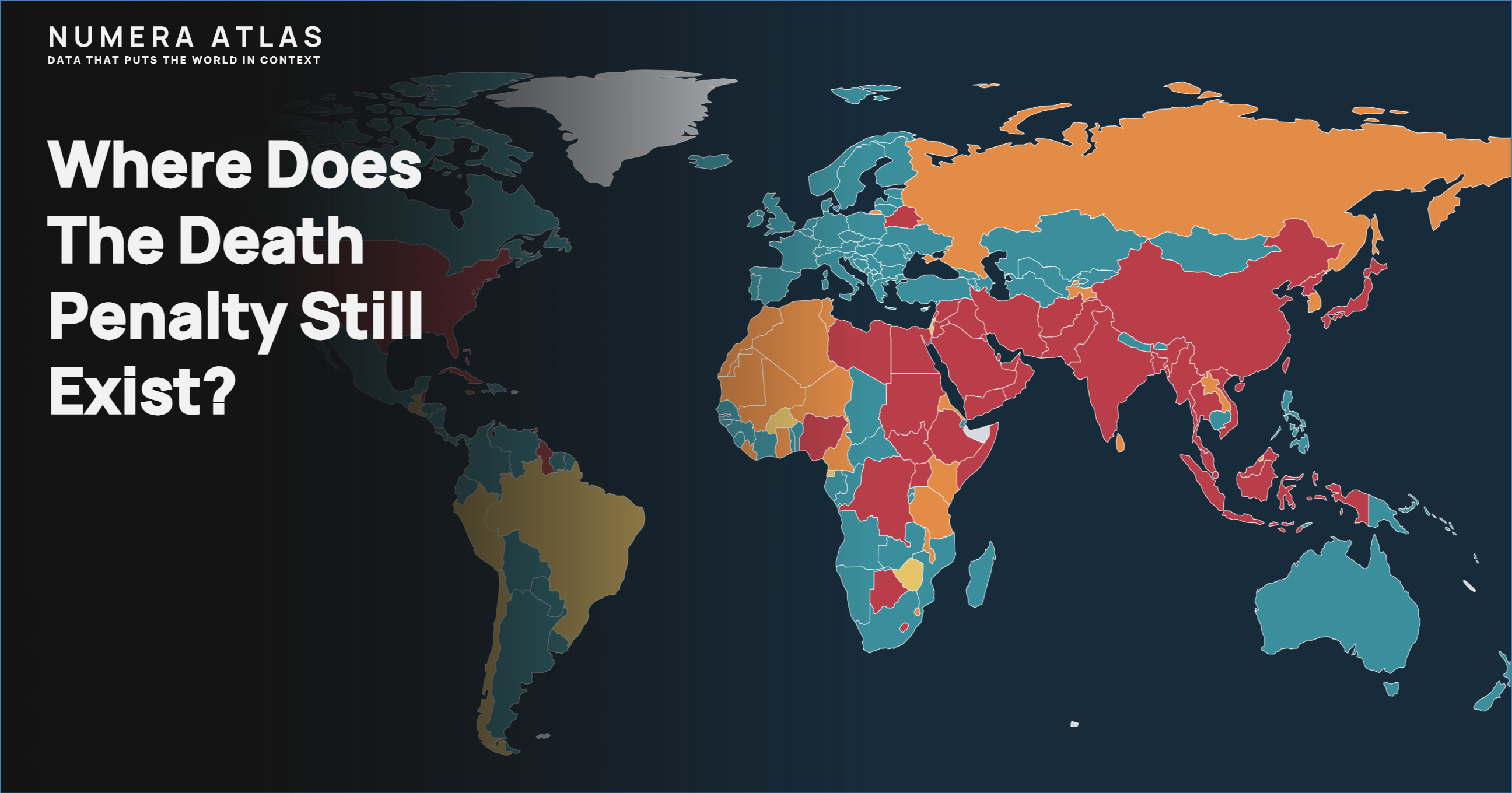
Full abolition means the death penalty is unavailable for any crime. Abolition for ordinary crimes leaves exceptions, such as certain military offences. Abolitionist-in-practice countries retain it for ordinary crimes but have an established policy or practice of non-use and no executions for at least ten years.
The UK and Australia were fully abolitionist; Brazil retained exceptional provisions; Russia was abolitionist in practice. China, India, Japan and the United States were retentionist. These are year-end classifications, not statements of today’s law.
Recorded executions increased by 78%
Amnesty recorded at least 2,707 executions across 17 countries in 2025, compared with 1,518 in 2024. This was its highest recorded annual total since 1981, excluding China.
The total is incomplete. It excludes the thousands believed to have been executed in China, alongside executions in North Korea and Vietnam for which credible totals were unavailable.
| Country | Executions recorded in 2025 |
|---|---|
| China | Thousands believed carried out; total unknown |
| Iran | At least 2,159 |
| Saudi Arabia | At least 356 |
| Yemen | At least 51 |
| United States | 47 |
| Egypt | 23 |
| Somalia | At least 17 |
| Kuwait | 17 |
| Singapore | 17 |
| Afghanistan | 6 |
| United Arab Emirates | 3 |
| Japan | 1 |
| South Sudan | 1 |
| Taiwan | 1 |
| Iraq | Recorded; credible minimum unavailable |
| North Korea | Recorded; credible minimum unavailable |
| Vietnam | Recorded; credible minimum unavailable |
Unknown totals must not be treated as zero.
Where did US executions take place?
The United States executed 47 people in 11 states during 2025. It was the only country in the Americas known to have carried out executions that year.
| US state | Executions in 2025 |
|---|---|
| Florida | 19 |
| Alabama | 5 |
| South Carolina | 5 |
| Texas | 5 |
| Tennessee | 3 |
| Arizona | 2 |
| Indiana | 2 |
| Mississippi | 2 |
| Oklahoma | 2 |
| Louisiana | 1 |
| Missouri | 1 |
| Total | 47 |
Source: Death Penalty Information Center, final 2025 year-end report.
Florida accounted for 40.4% of US executions. Combined with Alabama, South Carolina and Texas, four states accounted for 34 of 47 — 72.3%. These shares are calculated from the state totals.
The state list measures executions carried out during the year. Other states may retain capital punishment without conducting an execution, so the US colour on the global map cannot describe every state’s law or practice.
A country can retain the death penalty without carrying out executions that year. And an absence of recorded executions does not always establish that none occurred, particularly where information is restricted.
About the data
Legal status is dated 31 December 2025; execution figures cover January–December 2025. Sources: Amnesty International, Death Sentences and Executions 2025, and the Death Penalty Information Center’s final 2025 report.
Execution counts are documented totals or minimums, with unknown figures shown explicitly. Grey map areas are unclassified; some small countries are absent at the supplied boundary resolution.