Europe still produces around 60% of the world’s wine, but shrinking vineyards, weaker demand and increasingly volatile weather are reshaping an industry that has dominated global production for generations.

The big picture
Europe remains the center of global wine production, but the amount of wine coming from its vineyards is under pressure.
The European Union produced an estimated 136 million hectolitres of wine in 2025, around 60% of global production. Yet output fell 1.3% from 2024 and remained at one of the lowest levels recorded in recent decades.
This is part of a wider pattern. Global production reached only 227 million hectolitres in 2025, 9.4% below the five-year average and the third consecutive year of unusually low production.
The important story, however, isn’t simply that Europe produced less wine in 2025.
Several forces are occurring simultaneously: vineyards are disappearing, consumption is declining in many traditional wine-drinking countries, producers are deliberately controlling output in some regions, and increasingly unpredictable weather is making harvests more volatile.
Together, these trends raise a bigger question:
Is Europe’s wine industry experiencing a temporary production slump — or adjusting to a world that simply needs less wine?
Europe’s wine giants are slowly producing less
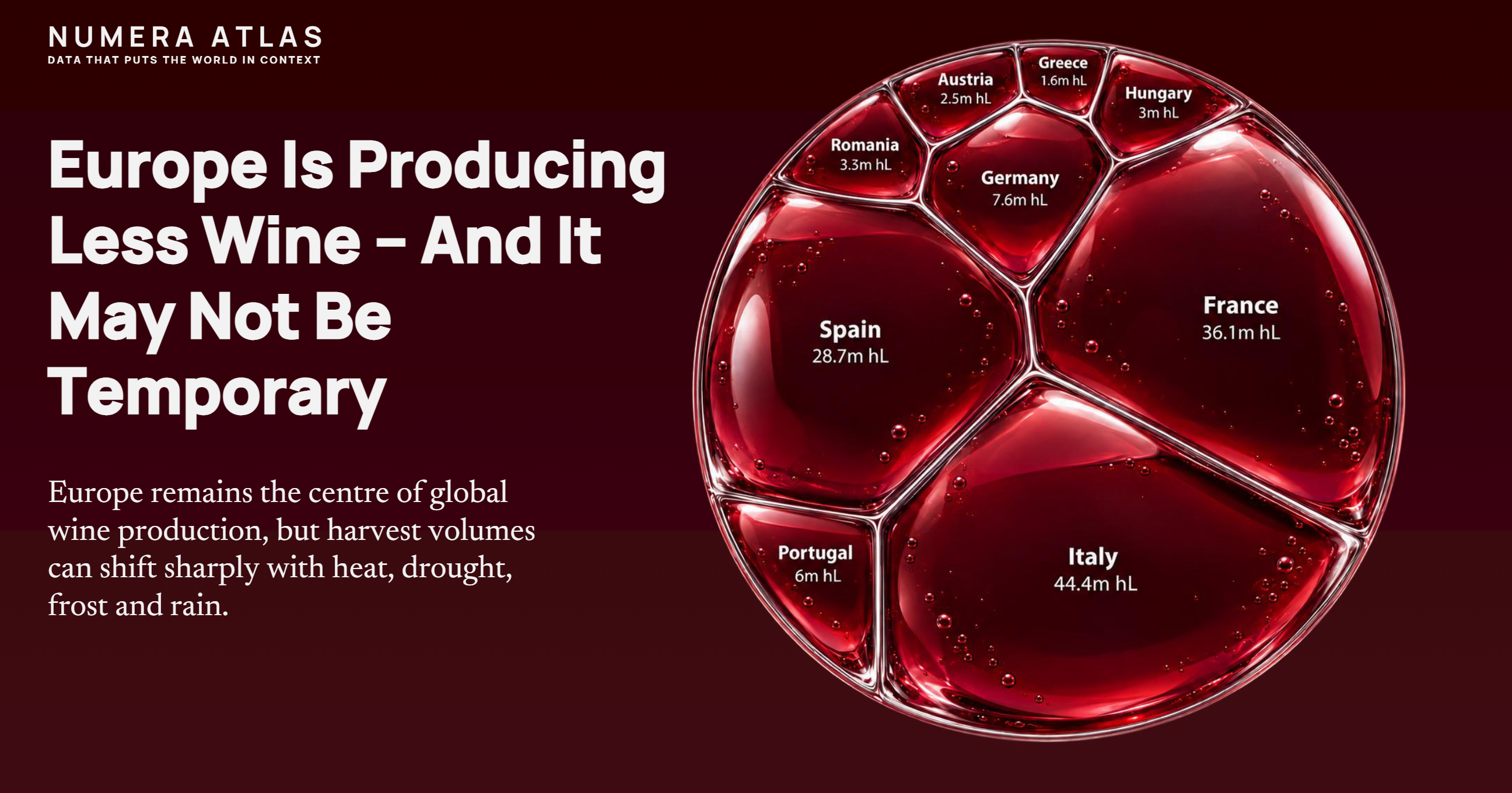
The scale of the change becomes clearer when 2025 production is compared with recent averages.
| Country | 2025 production | vs 2024 | vs 5-year average |
|---|---|---|---|
| 🇮🇹 Italy | 44.4 mhl | +0.7% | -4.1% |
| 🇫🇷 France | 36.1 mhl | -0.1% | -15.5% |
| 🇪🇸 Spain | 28.7 mhl | -7.7% | -16.6% |
| 🇩🇪 Germany | 7.6 mhl | -2.6% | -10.4% |
| 🇵🇹 Portugal | 6.0 mhl | -14.0% | -15.1% |
| 🇷🇴 Romania | 3.3 mhl | +3.7% | -17.6% |
| 🇭🇺 Hungary | 3.0 mhl | +10.0% | +1.1% |
| 🇦🇹 Austria | 2.5 mhl | +17.5% | +6.4% |
| 🇬🇷 Greece | 1.6 mhl | +16.8% | -14.6% |
Source: OIV. Figures exclude juices and musts; 2025 figures are preliminary.
The contrast is striking. Austria and Hungary enjoyed comparatively strong harvests, while Italy remained relatively stable. But several of Europe’s biggest producers were considerably below recent norms.
France produced about 15.5% less than its five-year average, Spain 16.6% less and Portugal 15.1% less.
That makes the European decline more than a story about a single poor vintage.
Europe’s vineyards are getting smaller
One of the strongest indications of structural change isn’t production at all, it’s land.
The EU’s vineyard area contracted 1.6% in 2025 to approximately 3.2 million hectares, although it still represents around 45% of global vineyard area. France and Spain accounted for much of the reduction.
Its vineyard area fell approximately 34,000 hectares in a single year, from 775,000 hectares in 2024 to 740,000 in 2025 — a decline of 4.4%.
Spain lost another 12,000 hectares, leaving 919,000 hectares under vines.
The weather is becoming harder to predict
The second pressure is climatic. The OIV reports drought, water stress and heat in some regions, while others experienced excessive rainfall, storms and greater disease pressure. The result was increasingly uneven production both between countries and within individual wine regions.
Spain provides one of the clearest examples. Production fell 7.7% in 2025 to 28.7 million hectolitres, leaving output around 17% below its five-year average in the OIV’s narrative estimate. A third consecutive year of drought and heatwaves reduced yields, with Castilla-La Mancha alone producing approximately 1.9 million hectolitres less than in 2024.
France faced a different combination. Heat and drought during August accelerated ripening while restricting grape growth. Its 36.1 million hectolitre harvest remained around 16% below its recent average.
Portugal moved from unusually heavy rainfall to intense heat, contributing to disease and drought stress. Production consequently fell 14% to 6.0 million hectolitres — its lowest level since 2011.
Europe is also drinking less wine
EU wine consumption fell to an estimated 100.6 million hectolitres in 2025, down 3.1% in a year and 6.9% below the five-year average.
Some of Europe’s largest wine markets recorded substantial declines:
Italy: -9.4%
Spain: -5.2%
Germany: -4.3%
France: -3.2%
Portugal was a notable exception, with consumption increasing 5.6% to a record 5.6 million hectolitres.
Worldwide wine consumption has fallen from 232 million hectolitres in 2020 to 208 million in 2025. The OIV estimates that global consumption has declined by around 14% since 2018.
A shrinking industry — or a rebalancing one?
The data does not establish that European wine production will continue falling every year. Wine harvests are inherently volatile, and countries such as Austria, Hungary and Greece demonstrated in 2025 how quickly production can rebound when growing conditions improve. But some of the forces behind today’s lower output are harder to reverse.
Weather-related production losses can recover. Vineyard removals, weaker consumption and deliberate reductions in output are more structural.
That combination suggests Europe may be undergoing a gradual adjustment in productive capacity rather than simply experiencing a sequence of unlucky harvests.
The demand problem may ultimately matter most
Globally, wine consumption fell another 2.7% in 2025, with nine of the world’s ten largest markets consuming less wine than the year before. Longer-term changes in lifestyles and social habits are being compounded by inflation, weaker purchasing power and changing behaviour among younger consumers.
Global wine exports fell 4.7% by volume and 6.7% by value in 2025, while average export prices remained historically elevated despite falling slightly.
Europe can produce less wine without necessarily creating a shortage because the world is simultaneously drinking and trading less of it.